Introduction
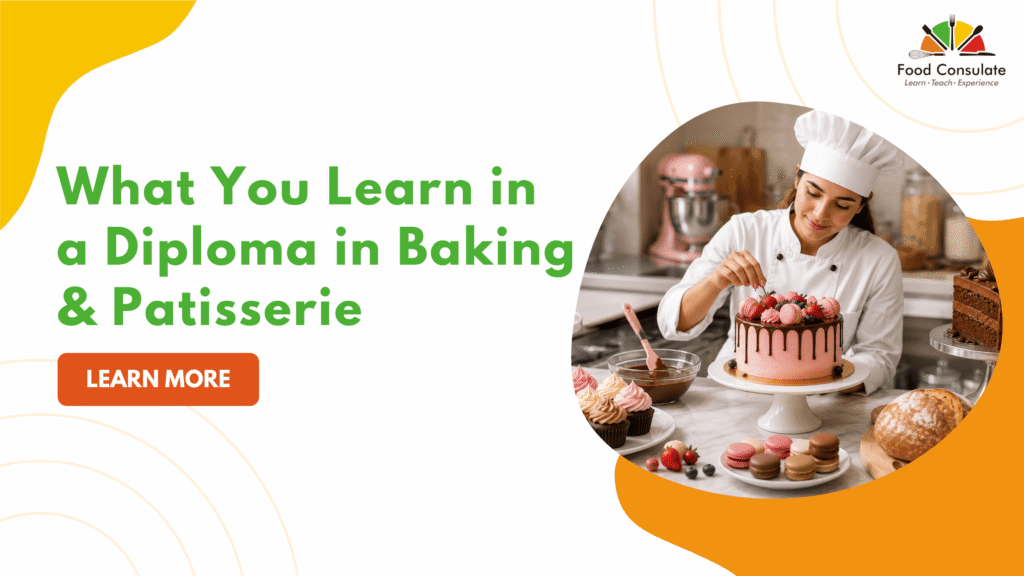
Baking and patisserie arts are among the most lucrative fields within food and hospitality today. The rise of specialised artisanal bakeries, dessert boutiques, luxury hotels, cafés, and bakery companies has created a growing demand for professionals who combine technical skill with creativity.
If you’ve ever considered becoming a baker or patissier, you may be wondering whether a professional diploma is worth pursuing. It certainly is. Beyond theoretical knowledge, a diploma program gives you the practical skills and hands-on experience that make the transition into a real bakery kitchen far smoother.
At Food Consulate, students gain exactly this — the knowledge and the practice needed to apply theory in a working kitchen and grow into a skilled professional baker or patissier.
This article walks through everything you can expect to learn in a Diploma in Baking & Patisserie, and how each part of the curriculum builds toward a successful career.
Understanding the Foundation of Baking
Every successful baker begins with the fundamentals. A diploma program introduces the basic principles that form the foundation of professional baking.
Baking Science
Baking is often described as a science, since precise measurements, ingredient functions, and controlled processes are essential for consistent results. Students learn:
- How ingredients interact with each other
- The role of flour, sugar, eggs, butter, and milk
- Functions of yeast and chemical leavening agents
- The effects of temperature on baking
- Moisture control and product texture
- Baking formulas and measurements
Understanding these principles helps students troubleshoot problems and produce consistent products batch after batch.
Ingredient Knowledge
A professional baker must understand the characteristics of the ingredients they work with every day. Students learn about:
- Different types of flour
- Sugars and sweeteners
- Dairy products
- Chocolate varieties
- Fruits and nuts
- Yeast and fermentation agents
- Fats and shortening
This knowledge guides students in selecting the right ingredients for specific recipes and bakery products.
Bread Making and Artisan Baking
Bread making is one of the most important components of a baking diploma. Students learn the complete bread production process, from dough to finished loaf.
Dough Preparation
- Mixing methods
- Kneading techniques
- Dough development
- Hydration levels
- Gluten formation
Fermentation and Proofing
Students gain a practical understanding of yeast activity, fermentation stages, dough maturation, proofing conditions, and temperature management.
Bread Production
Training covers a wide range of bread products, including:
- White bread
- Whole wheat bread
- Multigrain bread
- Dinner rolls and buns
- Brioche
- Focaccia
- Artisan breads
Learning bread making develops patience, precision, and technical competence — qualities that carry through every other area of the diploma.
Cake Production and Decoration
Cake making is one of the most popular areas within baking and patisserie. Students learn to create cakes from scratch while understanding the science behind different cake structures.
Types of Cakes
- Sponge cakes
- Butter cakes
- Chiffon cakes
- Tea cakes
- Layer cakes
- Celebration cakes
Frosting and Fillings
Students learn to prepare buttercream, whipped cream, ganache, cream cheese frosting, fruit fillings, and custards.
Cake Decoration Techniques
Professional presentation plays a significant role in the pastry industry. Students develop skills in:
- Piping techniques
- Border work
- Writing and lettering
- Fondant basics
- Cake finishing and decorative elements
These techniques are essential for custom cakes and celebration desserts.
Pastry Arts and Specialty Desserts
A Diploma in Baking & Patisserie extends well beyond traditional baking to include professional pastry production.
Pastry Dough Preparation
- Shortcrust pastry
- Sweet pastry
- Choux pastry
- Puff pastry
- Danish pastry
Understanding pastry preparation requires attention to detail and precise execution at every step.
Specialty Desserts
Training also includes a range of specialty desserts, such as:
- Tarts
- Éclairs
- Profiteroles
- Mousse desserts
- Cheesecakes
- Petit fours
- Modern plated desserts
These products introduce students to advanced pastry concepts and presentation techniques.
Viennoiserie Production
Viennoiserie refers to enriched bakery products made using laminated dough techniques, commonly found in cafés, bakeries, and hotels. Students learn to produce:
- Croissants
- Danish pastries
- Pain au chocolat
- Sweet rolls
- Filled pastries
Lamination Techniques
Key skills covered include:
- Butter block preparation
- Folding methods
- Layer development
- Temperature control
- Dough handling
Mastering laminated dough is considered an important milestone in professional baking education.
Cookies and Confectionery
Diploma programs also cover popular bakery products that are widely consumed and commercially successful.
Cookie Production
Students learn to prepare butter cookies, chocolate chip cookies, shortbread, filled cookies, and specialty cookies.
Chocolate and Confectionery Basics
Chocolate work is an important component of pastry education.
- Types of chocolate
- Cocoa content
- Chocolate handling
- Storage methods
Crystallisation Methods
Getting chocolate to set with the right shine, snap, and shelf life depends on proper crystallisation. Students learn two core methods used in professional kitchens:
- Tabling method: Working melted chocolate on a cool marble or steel surface to bring it to the right working temperature.
- Seeding method: Stirring in small pieces of already-tempered chocolate to encourage stable crystal formation throughout the batch.
Both methods are practiced hands-on so students can produce chocolate with a glossy finish, a clean snap, and good shelf stability.
Chocolate Decorations
Students practice chocolate garnishes, decorative shapes, and simple chocolate artistry. Chocolate skills add significant value to a baker’s professional portfolio.
Doughnuts and Sweet Breads
Many modern bakeries feature doughnuts and enriched sweet products as core menu items. Students learn:
- Doughnut dough preparation
- Frying techniques
- Glazing methods
- Filled doughnuts
- Cinnamon rolls and sweet buns
- Babka
- Brioche products
These products combine bread-making skills with pastry techniques, bridging two areas of the curriculum.
Food Safety and Hygiene
Food safety is a critical part of every professional baking program. Students learn industry-standard hygiene practices, including:
Personal Hygiene
- Proper handwashing
- Uniform standards
- Workplace cleanliness
Food Handling
- Safe ingredient storage
- Temperature control
- Contamination prevention
Workplace Safety
- Equipment handling
- Accident prevention
- Kitchen safety procedures
Professional kitchens place significant importance on food safety compliance, and this runs through every practical session in the diploma.
Bakery Equipment and Technology
Modern bakeries rely on specialised equipment, and students gain practical, hands-on exposure to:
- Deck ovens
- Convection ovens
- Planetary mixers
- Dough sheeters
- Proofing cabinets
- Refrigeration systems
Learning to operate professional equipment prepares students for real industry environments from day one on the job.
Production Planning and Time Management
Professional baking requires more than technical skill — it demands organisation under pressure.
Workflow Planning
- Organising production schedules
- Sequencing tasks efficiently
- Managing preparation timelines
Batch Production
Students also learn to scale recipes accurately, maintain consistency across batches, and manage large-volume production — all essential skills for commercial bakery operations.
Costing and Basic Bakery Management
Many diploma programs introduce students to business fundamentals that prove valuable well beyond the kitchen.
Product Costing
Students learn how to calculate ingredient costs, production expenses, selling prices, and profit margins.
Inventory Management
Topics covered include stock control, ingredient management, and waste reduction — concepts that are especially valuable for students interested in entrepreneurship.
Creativity and Product Development
Innovation plays an important role in modern baking and pastry arts. Students are encouraged to:
- Experiment with flavours
- Develop unique products
- Improve presentation techniques
- Explore industry trends
Creative thinking helps professionals stand out in a competitive market.
Industry Exposure and Practical Training
One of the biggest advantages of a diploma program is hands-on experience. Students spend significant time practising techniques under professional supervision, which helps them:
- Build confidence
- Improve speed and efficiency
- Develop discipline
- Learn teamwork
- Adapt to industry expectations
This real-world experience makes the transition from classroom to workplace much smoother.
Career Opportunities After a Diploma in Baking & Patisserie
A diploma opens doors to a wide range of career paths. Graduates can pursue roles such as:
Baking Careers
- Baker
- Artisan Bread Specialist
- Bakery Production Assistant
- Bakery Supervisor
Pastry Careers
- Pastry Chef
- Pastry Commis
- Cake Decorator
- Dessert Specialist
Entrepreneurship
Another alternative open to graduates is venturing into entrepreneurship by establishing their own enterprises like home baking enterprises, cake companies, unique desserts businesses, or artisan baking businesses. This kind of flexibility makes the diploma useful for work and entrepreneurship.
Why Choose a Professional Diploma?
Although online cooking classes may help students understand how to make some basic dishes, a professional diploma course will provide them with more benefits such as learning from experts, practical experience, industry standard equipment training, professional critique, and skills necessary for their future career.
All these benefits make a diploma course more valuable for acquiring employment within the hotel and bakery industry.
Conclusion
A diploma in Baking & Patisserie is more than just learning how to prepare food products. It includes an insight into the science of baking and includes courses on bread baking, patisserie artistry, cake decoration, chocolate confectionery, food safety, food production management, and kitchen operations.
These combinations of theoretical knowledge, practical experience, and creativity ensure that the diploma holders get good jobs in bakeries, hotels, restaurants, cafes, or even start a venture of their own.
The training offered by Food Consulate is industry oriented and aimed at developing self-confidence, good professional practices, and future career success in the baking and patisserie industry.
If your goal is to become a professional baker, patissier, cake decorator or entrepreneur in the baking and patisserie industry, then the diploma in Baking & Patisserie might be what you need.